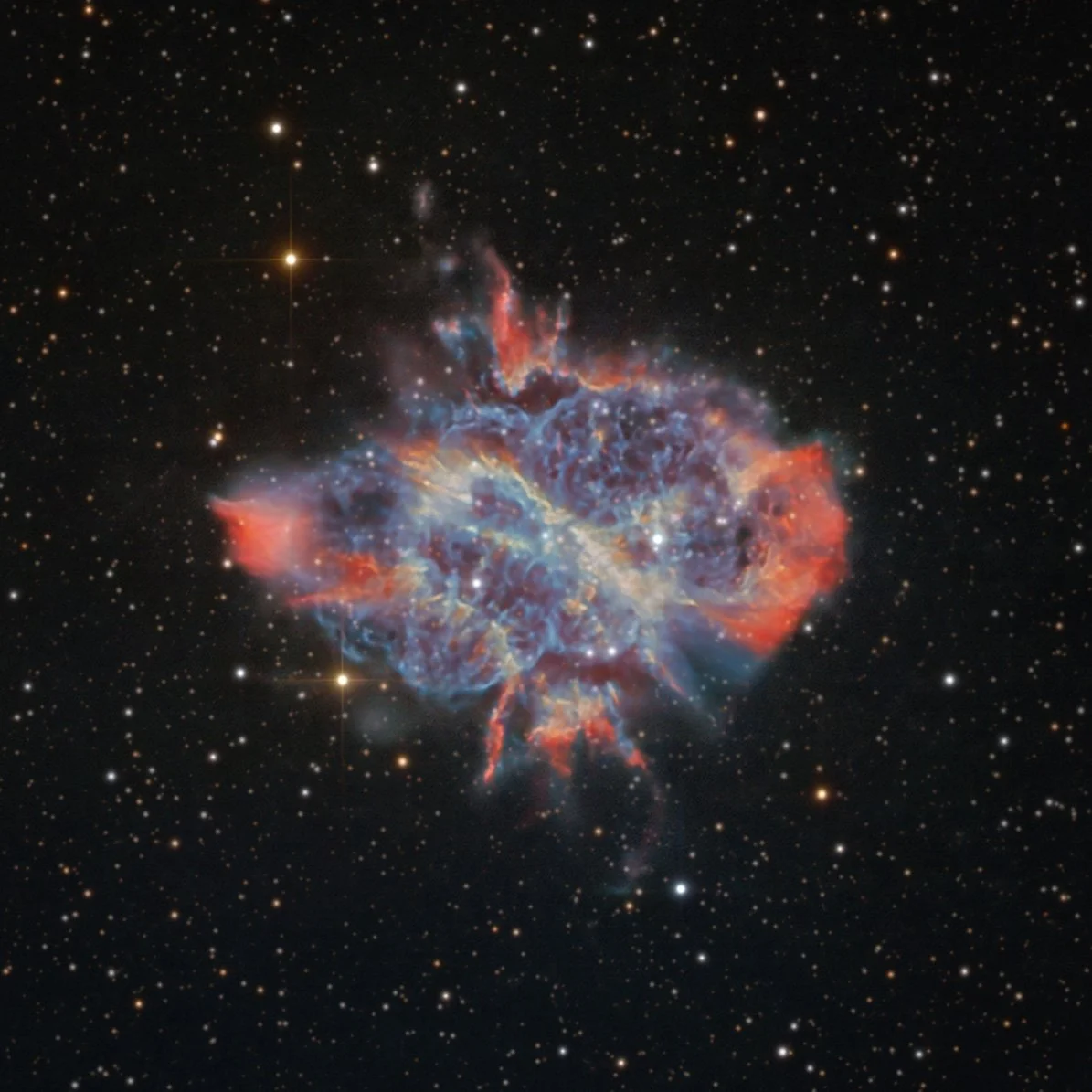
NGC 5189 Planetary Nebula
NGC 5189 is among the most intricately structured planetary nebulae visible in our night sky. Its vibrant display of colors—yellow for sulfur, red for hydrogen, and blue oxygen—maps out the last emissions of a star as it sheds its outer layers. These elements enrich the nearby interstellar space, providing material that may form new stars and planets in the future.
Situated about 3,000 light-years away within the constellation Musca, NGC 5189 has earned the name Spiral Planetary Nebula due to its dramatic, complex swirls of luminous gas. Unlike the typical bubble-shaped envelopes seen around dying stars, this nebula presents a chaotic landscape filled with twisted strands and knots spanning distances similar to our solar system.
The nebula’s distinctive shape results from the gravitational interplay between the two central stars: a hot Wolf-Rayet star—the exposed core of a faltering sun—and its companion, a compact white dwarf. With an orbital period of just a few days, their interaction produces shifting axes reminiscent of a spinning lawn sprinkler, ejecting material outward in various directions. This phenomenon, called precession, sculpts the unique, symmetrical lobes that give NGC 5189 its spiral, galaxy-like appearance.
Imaged in RGBHa on a Planewave CDK 24 at Observatorio El Sauce, Chile. Taken Moravian C5.
24 x 300 for each R, G, B and 36x600 for each HA, S2 and O3.
Enjoy,
SWOS Group, Mazlin, Parker, Forman, Magill, Hanson
Enjoy, Mark