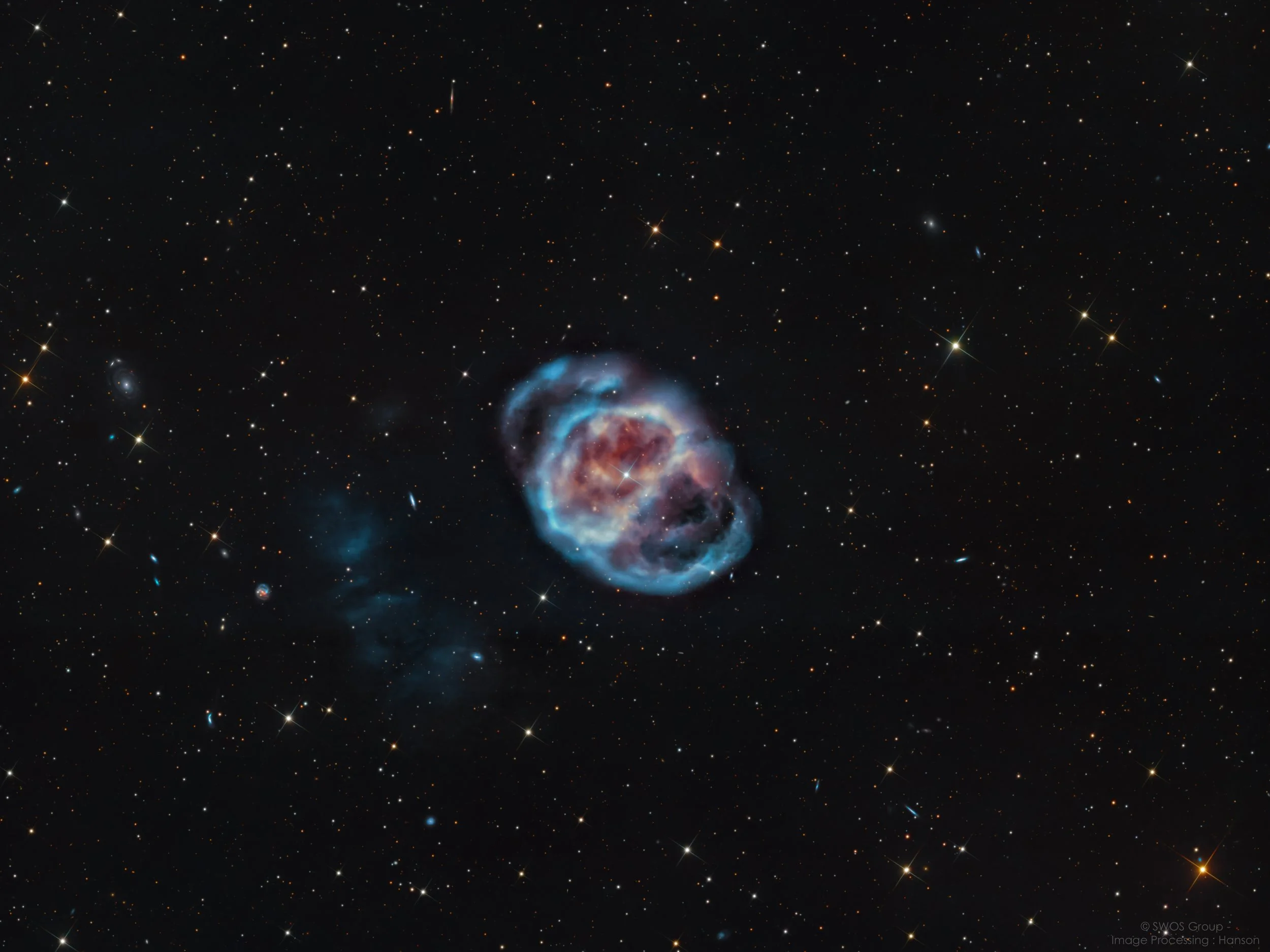
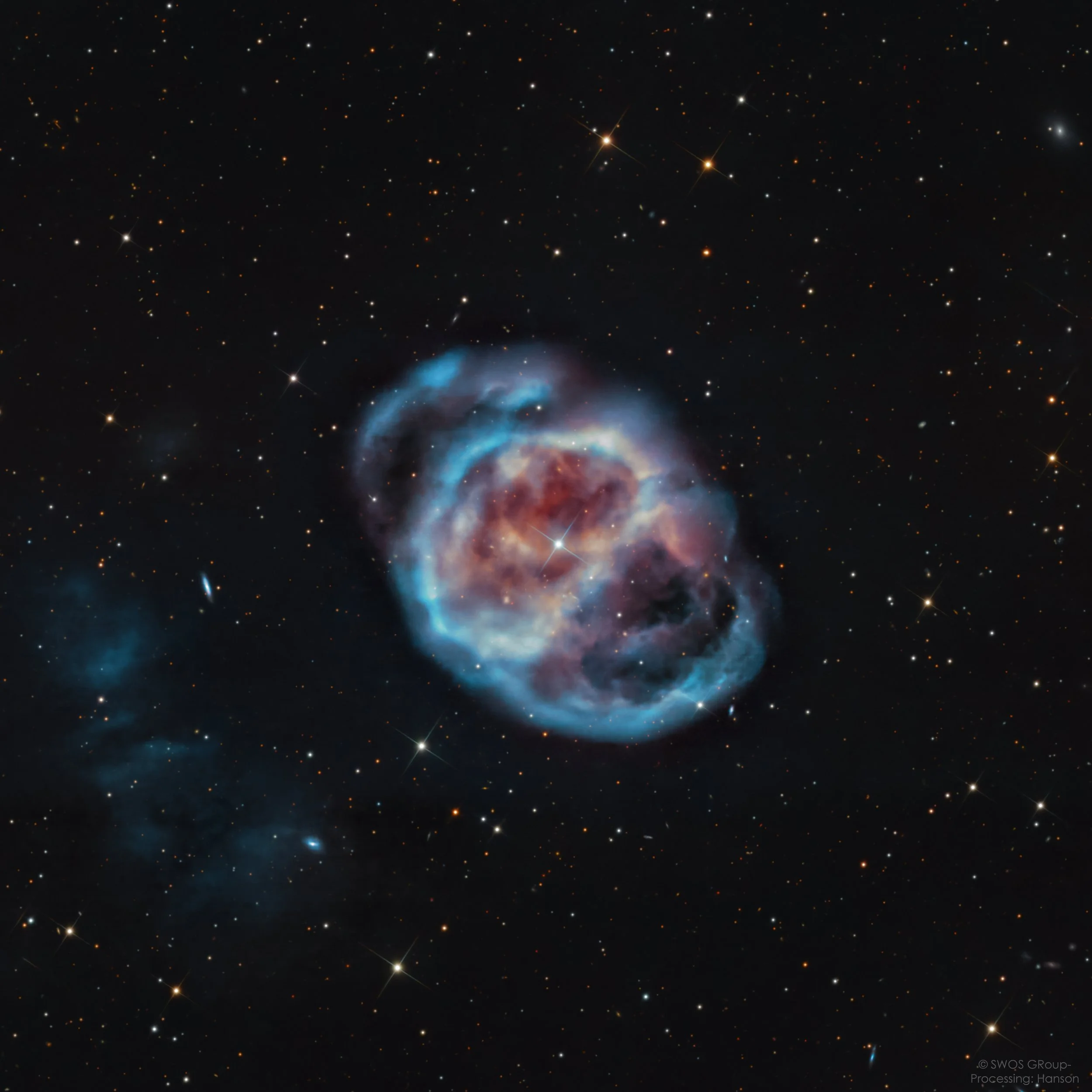
“The Ghostly Final Breath of a Sun-Like Star”
Abell 36 is a striking cosmic shroud about 800 light-years away in the constellation Virgo. Discovered in 1955 by American astronomer George Ogden Abell, this planetary nebula marks the hauntingly beautiful final stage of a dying Sun-like star. Despite its name, it is unrelated to planets; instead, it is an expanding shell of gas and plasma released as an aging star sheds its outer layers.
At the center of this celestial tapestry, a contracting star is evolving into a white dwarf. Though rapidly shrinking, the stellar remnant remains intensely hot, with a surface temperature above 73,000 Kelvin. It emits powerful ultraviolet radiation that ionizes the surrounding expelled gases, making them glow like a vast neon sign in the cosmic darkness.
Spanning roughly 1.5 light-years, the nebula displays striking symmetry and complexity. Its inner core forms an intricate bipolar, figure-eight pattern, with columns of gas sculpted by magnetic fields and stellar winds.
For astrophotographers, it reveals its true majesty when mapped to the SHO—or Hubble—palette uses narrowband filters to capture emissions from ionized sulfur, hydrogen-alpha, and doubly ionized oxygen, assigning them too red, green, and blue, respectively. The glowing structure is surrounded by a vast, extremely faint halo of ancient material.
Like all planetary nebulae, Abell 36 is beautiful but short-lived and is estimated to have formed about 10,000 years ago. As its gas expands into the interstellar medium, it will become too thin and cold to glow, fading into the surrounding universe within another 10,000 years. Studying this fleeting phenomenon offers a sobering glimpse of our own future because it reflects the fate awaiting the Sun in about 5 billion years.
Imaged in RGBHaO3 on a Planewave CDK 24 at Observatorio El Sauce, Chile. Taken Moravian C5.
36 x 300 sec for each R-G-B, 48 x 600 sec for Ha 56 x 300 O3 and 18 x 600 S2.
SWOS Group, Mazlin, Forman, Magill, Hawn, Stafforini, Hanson
Enjoy,
Mark and SWOS group.