The Crab Nebula: Echoes of a Stellar Cataclysm
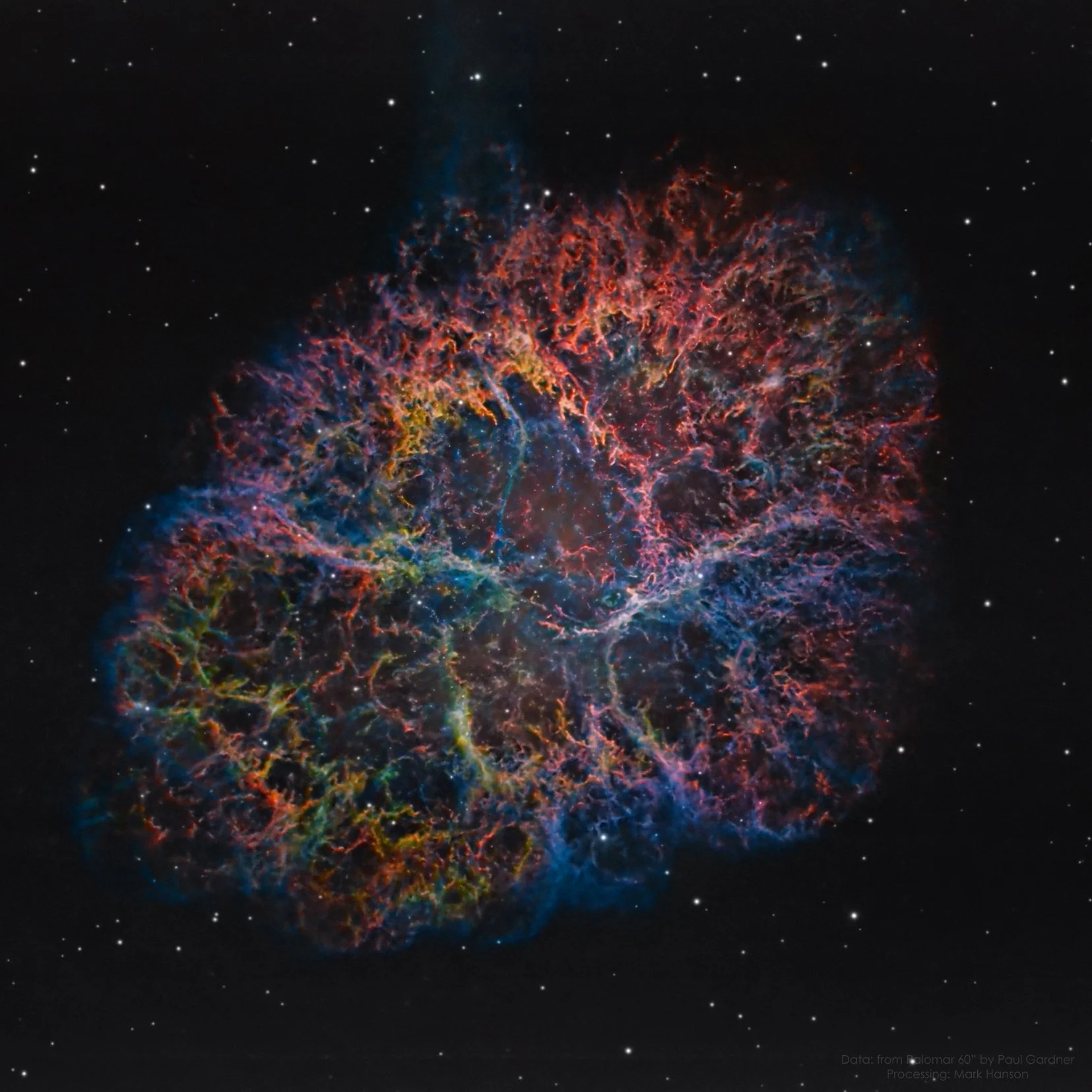

The Crab Nebula is a violent, beautiful masterpiece of cosmic destruction, born from a spectacular stellar death rattle that shattered the night sky. In the year 1054 AD, a dying giant star exploded into a supernova so devastatingly bright it was visible to ancient astronomers in broad daylight for weeks. Today, that ancient explosion has transformed into an expanding, tangled web of colorful gas clouds located 6,500 light-years away in the Taurus constellation. Captured in this image in stunning detail by historic ground-based instrument 60-inch Telescope at Palomar Observatory by Paul Gardner, it serves as a hauntingly beautiful, active crime scene of a massive star's final moments.
Step into its chaotic interior, and you will find a roaring furnace of brilliant, multi-colored filaments tearing through space at millions of miles per hour. Shockwaves of sulfur, oxygen, and hydrogen glow in vibrant shades of red, green, and blue, creating an intricate celestial tapestry. Pushed outward by unstoppable energy, this glowing shockwave of stellar guts spans over six light-years across, continuing to devour and light up the darkness of the surrounding cosmos.
Deep within this glowing heart of fire lies a terrifyingly powerful engine: the Crab Pulsar. This hyper-dense remnant of the original star compressed an entire sun's worth of mass into a sphere just a few miles wide. It spins at a staggering, dizzying speed of 30 times per second. As it whips around, it acts as a cosmic dynamo, blasting out twin beams of deadly radiation and high-energy particle winds that whip the surrounding nebula into a glowing, chaotic frenzy.
Witnessing the Crab Nebula through modern space observatories like Hubble and James Webb reveals a dynamic powerhouse of physics that bridges our human past with the deep future of our universe. It is not a quiet, dead relic of a long-ago blast, but a living, breathing storm of cosmic energy. It stands as a brilliant, glowing monument to the fact that when stars die, they do not go quietly into the night—they reshape the galaxy forever.
You can see its cataloged expansion in this nice video here by Adam Block.
Data was acquired on the 60” at Palomar 2-14-2014 using an Apogee U16M. 300secx7 for each HA, O3 and S2 and RGB Stars New Mexico in 2014 14.5 RCOS
Enjoy,
Paul and Mark