NGC 3576 - 3603
The Statue of Liberty Nebula
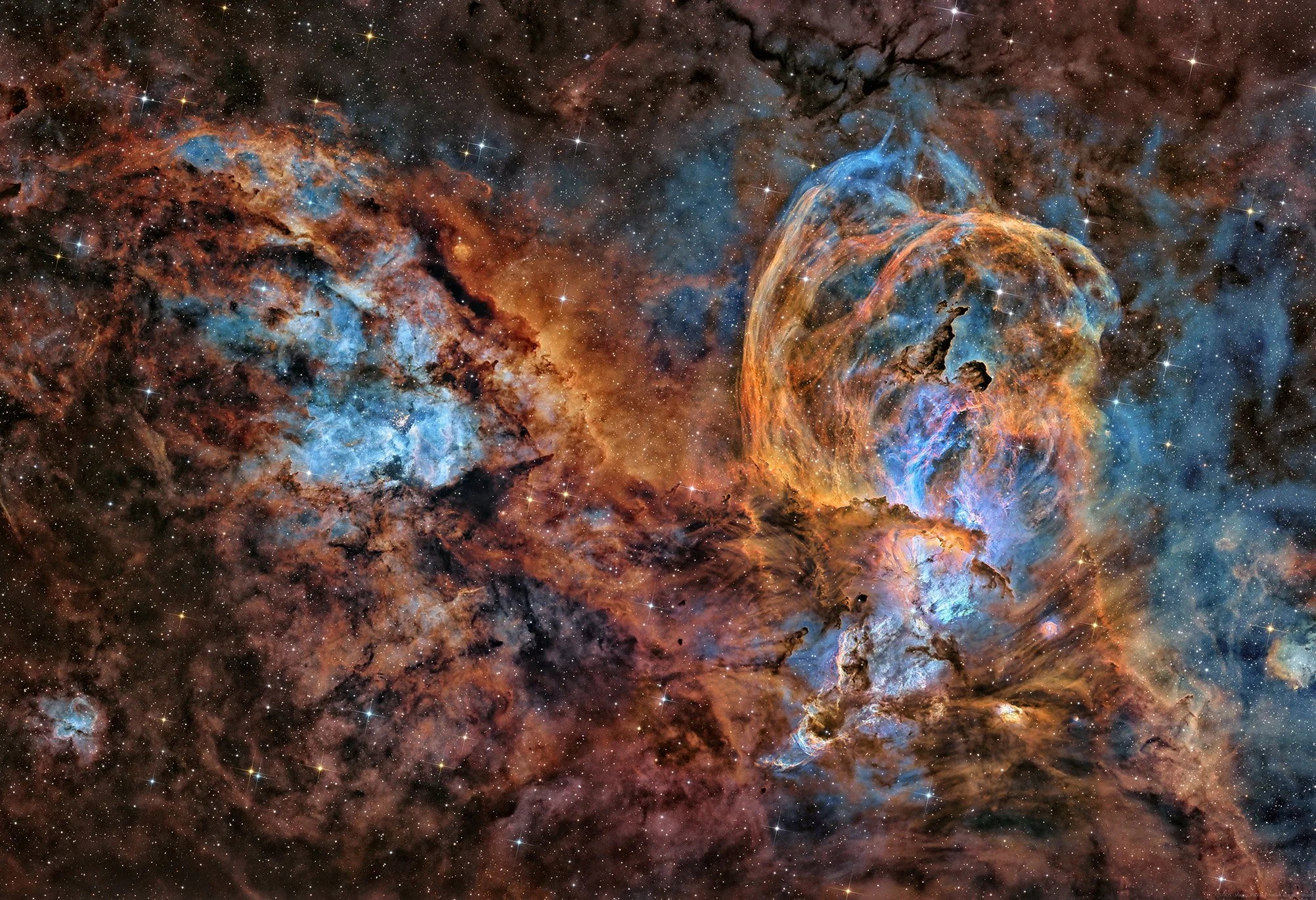
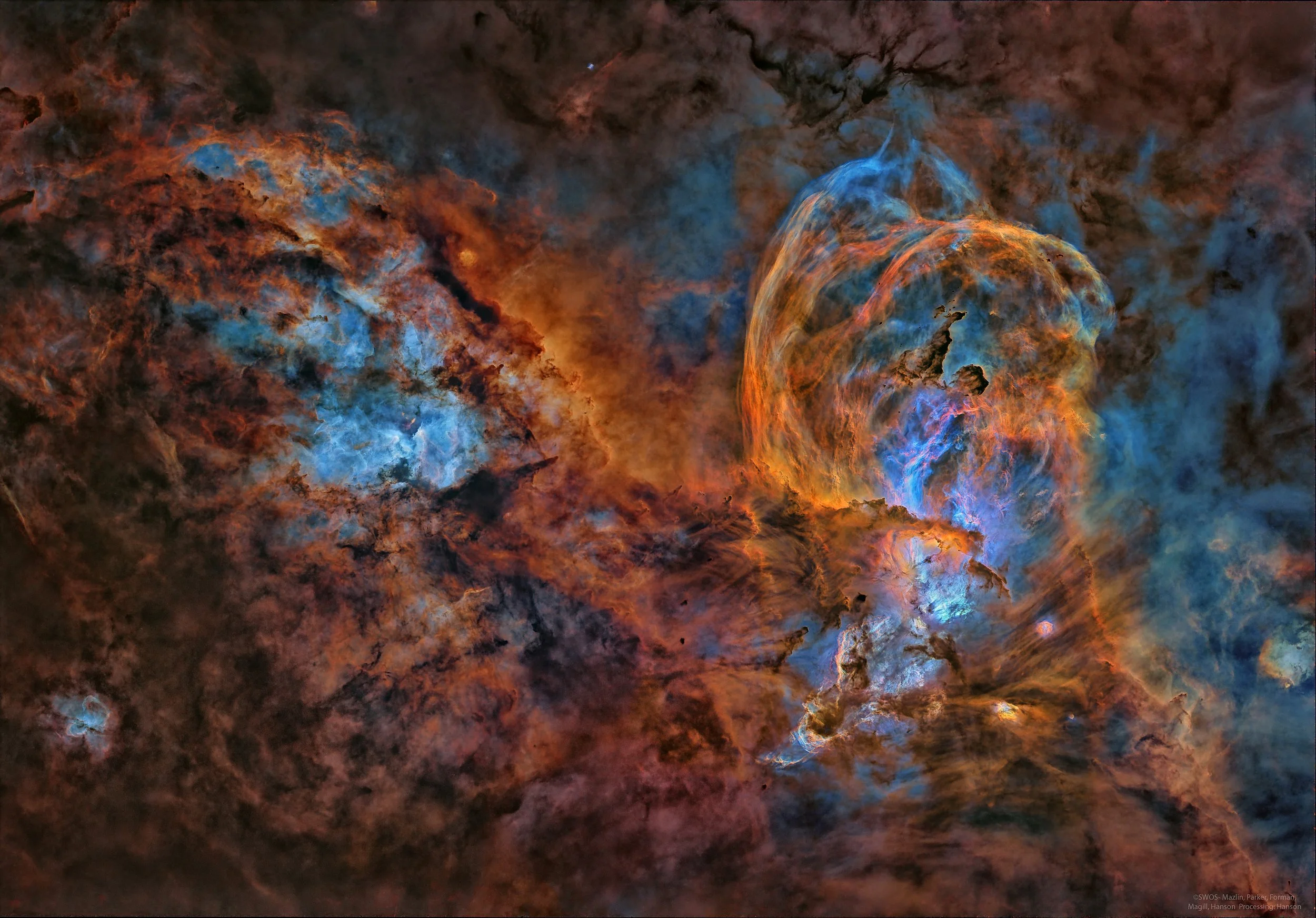
This is a 2-panel mosaic of NGC 3567 and 3603, taken in RGBSHO. Full Versions can be seen here: https://app.astrobin.com/u/Mhanson?i=ibj24r
A particularly striking feature within this sprawling complex (on the right side of this image) is the Statue of Liberty Nebula (specifically associated with the region NGC 3576). This nebula earned its nickname by astrophotographer Steve Mazlin, due to the distinct, torch-like shape of its ionized gas clouds, which bear a resemblance to the iconic monument in New York Harbor. These dramatic silhouettes are dense pillars of gas and dust—known as "Bok globules"—that are currently being eroded by the radiation of nearby stars. While the "statue" appears serene from a distance, it is actually a site of chaotic activity where new stars are actively forming within the dark, protective folds of the cosmic dust.
Located on the left of this image within the Carina spiral arm of our galaxy, the NGC 3603 nebula complex is one of the most massive and luminous star-forming regions in the Milky Way. At its heart lies a compact, "super" star cluster containing thousands of young stars, including some of the most massive and hottest stars known to science. The intense ultraviolet radiation and powerful stellar winds from these cosmic giants have carved out a massive cavity in the surrounding gas and dust, creating a celestial laboratory where astronomers can study the violent processes of star birth and the resulting impact on the interstellar medium.
Imaged in RGBHa on a Planewave CDK 24 at Observatorio El Sauce, Chile. Taken Moravian C5.
24 x 300sec for each R-G-B and 60x300sec for each-HA-O3-S2
Enjoy,
SWOS Group, Mazlin, Parker, Forman, Magill, Hanson
OLD Versions Below.
NBeautiful data from Martin Pugh’s CDK 24. This is the first image I have ever processed from a laptop while on vacation.
NGC 3576 is a bright emission nebula in the Sagittarius arm of the galaxy a few thousand light-years away from the Eta Carinae nebula. It is approximately 100 light years across and 9000 light-years away from Earth. John Frederick William Herschel discovered it on 16 March 1834.
Throughout the nebula, episodes of star formation are thought to contribute to the complex and suggestive shapes. Powerful winds from the nebula's embedded, young, massive stars shape the looping filaments.
This nebula has received six different classification numbers. Currently, astronomers call the entire nebula NGC 3576. A popular nickname is "The Statue of Liberty Nebula" because of the distinctive shape in the middle of the nebula. The name was first suggested in 2009 by a friend of mine Dr. Steve Mazlin
Image Processing and Calibration: Mark Hanson
Image Data: Maritn Pugh, El Sauce Chile
Enjoy,
Mark Hanson

NGC 3576
is a minor nebula in the Sagittarius arm of the galaxy a few thousand light-years away from the Eta Carinae nebula. This nebula even received six different classification numbers. Currently, astronomers call the entire nebula NGC 3576. A popular nickname is "The Statue of Liberty Nebula" because of the distinctive shape in the middle of the nebula. The name was first suggested in 2009 by Dr. Steve Mazlin, a member of Star Shadows Remote Observatory (SSRO).

RGB-HA-03-S2

RGB-HA
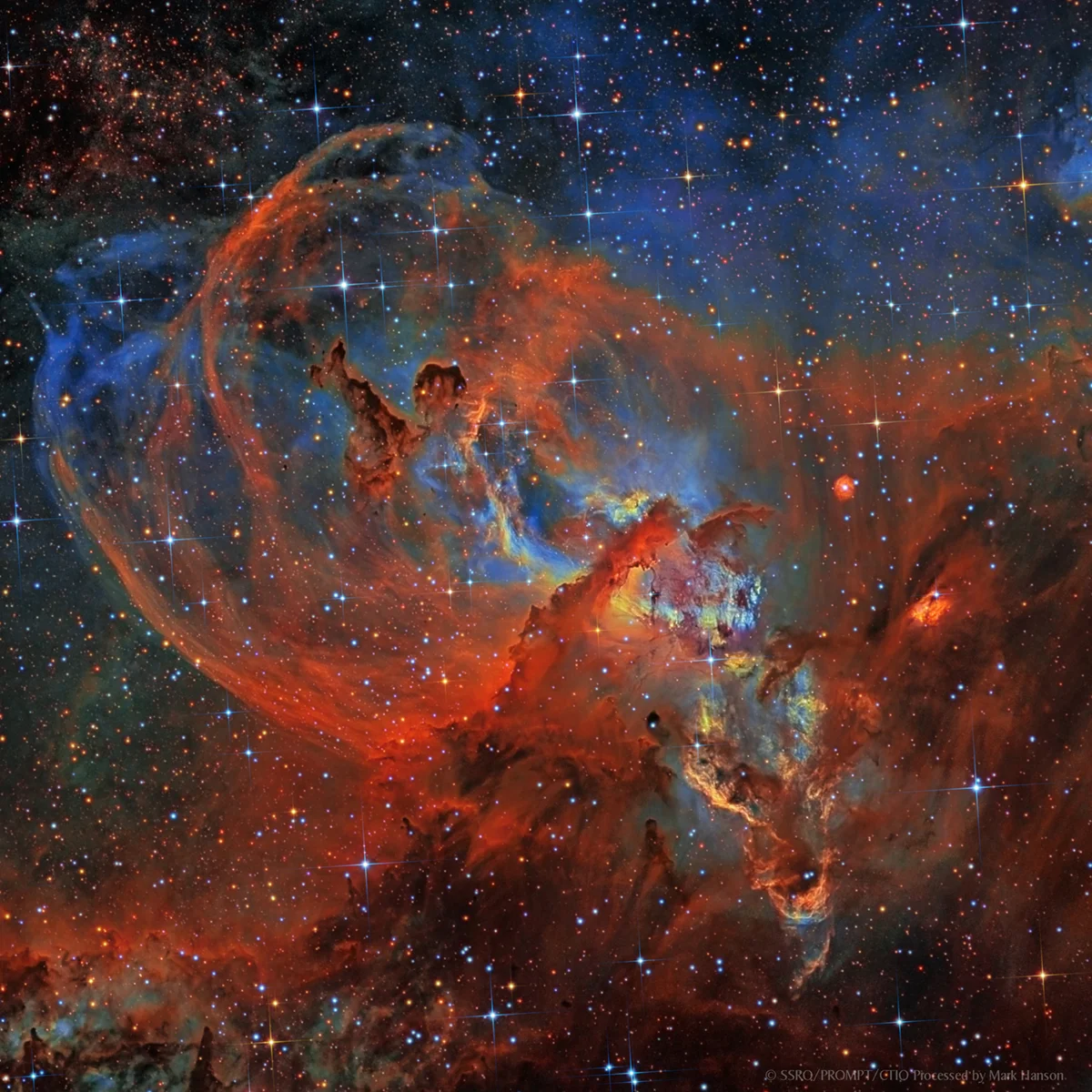
HA-03-S2-RGB stars